Managed AI Ops · 5 min read
Conversational AI for Service Businesses
A service-operator guide to conversational AI for intake, scheduling, support, escalation, and managed AI Ops.
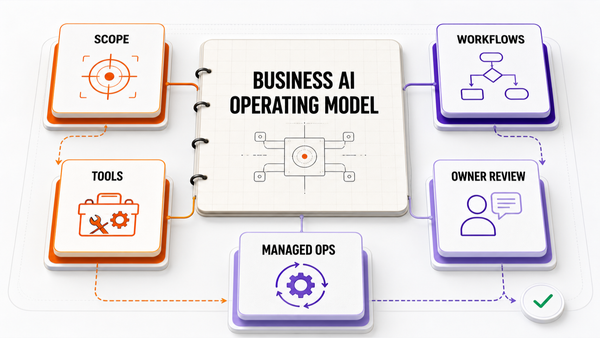
The Omni model: one managed AI Employee owns one recurring workflow; specialist employees add capacity around the same business context; your team keeps the judgment calls.

Direct answer: Conversational AI helps service businesses when it is attached to a specific workflow: answer a call, collect intake details, classify urgency, suggest a route, book a follow-up, or escalate an exception. It becomes risky when it is treated as a general chatbot with no source rules, no audit trail, and no human approval for edge cases.
Keyword cluster this article supports
- conversational ai
- ai assistants
- ai conversation
- conversational ai apps
- conversational ai services
- conversational ai agents
AI operating models for a service business compared
| Model | Effort | Control | Ongoing ops | Best for |
|---|---|---|---|---|
| DIY with off-the-shelf tools | High | Full | Owner-run | Technical owners with time |
| Agency build, then hand off | Medium | High at build | Owner-run after launch | One-time projects |
| Managed AI Ops (Omni Studio) | Low for buyer | Approval-gated | Operator-run with owner sign-off | Owners who want outcomes, not tooling |
Conversational AI is only useful when the workflow is specific
A service business does not need a chatbot that can talk about everything. It needs a conversation system that knows what information matters before a job can move forward.
That means the AI should be tied to the real operating flow: what type of request is this, how urgent is it, what details are missing, where should it go, and who has to approve the next step.
The best starting points
The safest starting points are repetitive, structured conversations. Examples include missed-call follow-up, appointment confirmation, estimate status, service intake, route-window reminders, review requests, and basic support triage.
These workflows are useful because the AI does not need to invent business policy. It follows a known path, asks for missing details, and hands exceptions to a human.
Where conversational AI can create risk
Conversational AI becomes risky when it makes promises that the business has not approved. That can include quoting too early, confirming availability without dispatcher review, ignoring safety signals, or giving policy answers from stale information.
The fix is not to avoid AI. The fix is to design approval gates, fallback paths, and review logs before customers depend on the workflow.
What operator-grade conversational AI includes
- A defined intake script and allowed decision boundaries.
- Clear escalation rules for urgent, angry, uncertain, or high-value requests.
- Conversation summaries that feed dispatch, CRM, or follow-up tools.
- Monitoring for failed intents, long calls, repeated confusion, and bad handoffs.
- Human approval before price, scheduling, safety, or account-sensitive promises.
How Omni Studio frames the work
Omni Studio treats conversational AI as part of managed AI Ops. The conversation is only one layer. The deeper work is source mapping, routing design, permission boundaries, QA, monitoring, and continuous workflow review.
For operators, that means the system should not feel like a novelty chatbot. It should feel like a cleaner intake and follow-up layer around the work the team already does.
What to define before launch
Before launch, document what the AI is allowed to say, what it is allowed to ask, and which systems it can update. The workflow should also define what happens when a customer asks for something outside the script.
For example, a scheduling assistant may collect preferred windows and job context, but it should not promise an arrival time unless the dispatcher or scheduling rules support that promise. A support assistant may explain next steps, but it should not invent warranty policy from an old note.
How to QA conversational AI
QA should include real-world conversation tests, not just happy-path demos. Test urgent calls, vague requests, angry customers, missing data, tool failures, and customers who change topics mid-conversation.
The review process should produce a short list of changes: better prompts, better source data, clearer escalation rules, or a smaller allowed action set. That is how the workflow gets more reliable without pretending every conversation can be fully automated.
What success should look like
Success should look like fewer abandoned conversations, cleaner handoffs, faster follow-up, and better visibility into the requests that still need human judgment. The AI should reduce repetitive work without hiding uncertainty from the team.
Operators should also be able to inspect the workflow. If a customer was escalated, the team should know why. If the AI failed to answer, the team should know whether the cause was missing source data, unclear policy, a tool failure, or a conversation pattern that needs a new rule.
That review loop matters because conversational AI is never finished at launch. Service rules change, customer questions change, and the business learns which exceptions happen most often. The operating cadence is what keeps the assistant useful.
A simple monthly review is enough to turn those lessons into better routing, clearer scripts, and fewer manual corrections.
Internal routes to review next
Start with Managed AI Ops if you want the operating model. Use the AI Ops readiness scorecard to check whether your workflows have enough clarity for automation.
For related implementation guidance, read AI agent monitoring dashboards and AI agent guardrails for small business.
Conversational AI For Service Businesses FAQ
What is conversational AI for a service business?
It is AI that handles structured customer or internal conversations tied to a business workflow, such as intake, scheduling, support triage, follow-up, or escalation.
Is conversational AI safe for customer calls?
It can be safe when the system has clear scripts, source rules, escalation paths, transcript review, and human approval for exceptions. It is not safe as an open-ended chatbot making unsupported promises.
What should be measured after launch?
Measure missed intents, escalation quality, booking accuracy, handoff quality, customer confusion, source freshness, and how often humans have to correct the workflow.
References
Authoritative sources referenced in this article:
Who this is for
This guide is for service-business operators evaluating conversational AI, AI receptionist workflows, and managed AI Ops.
How this was built
Omni Studio structured this article from service-business operating workflows, including intake, routing, follow-up, approval gates, and back-office handoffs that affect conversational AI for service-business operations.
Why this exists
The goal is to help operators separate useful AI implementation decisions from tool-first automation that lacks ownership, review, or measurable operating proof.
Last reviewed: July 1, 2026 by Omni Studio.
Outside reference: NIST frames AI risk management around governance, measurement, and ongoing management, which is the same operating lens owners should use before putting AI into live customer workflows. See NIST AI Risk Management Framework.