AI Implementation · 5 min read
AI Front Office for Small Business: Calls, Intake, Scheduling, and Follow-Up
A practical guide to AI front office workflows for small businesses that need intake, scheduling, follow-up, and approval control.
The Omni model: one managed AI Employee owns one recurring workflow; specialist employees add capacity around the same business context; your team keeps the judgment calls.

Direct answer: An AI front office is a controlled workflow that uses AI to answer routine demand, collect intake details, draft scheduling or follow-up steps, and route exceptions to a human. For a small business, the value is not just faster replies. The value is cleaner handoffs, fewer missed details, and visible approval before customer promises are made.
What this workflow actually covers
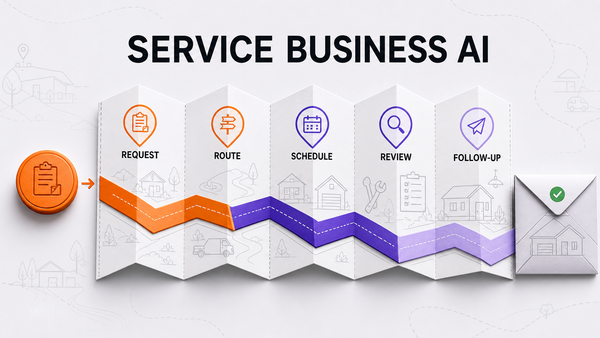
AI Front Office for Small Business: Calls, Intake, Scheduling, and Follow-Up is not about adding another generic AI tool. It is about designing calls, intake, scheduling, follow-up, and owner review so the small business owner can capture demand, move routine work forward, and still see the moments that need judgment.
The practical workflow starts with a trigger, such as a call, form, email, invoice state, calendar request, or customer note. AI can collect the required fields, summarize context, classify the request, and prepare the next action. The business still needs a named owner, a source of truth, and a rule for what the AI may not do alone.
AI operating models for a service business compared
| Model | Effort | Control | Ongoing ops | Best for |
|---|---|---|---|---|
| DIY with off-the-shelf tools | High | Full | Owner-run | Technical owners with time |
| Agency build, then hand off | Medium | High at build | Owner-run after launch | One-time projects |
| Managed AI Ops (Omni Studio) | Low for buyer | Approval-gated | Operator-run with owner sign-off | Owners who want outcomes, not tooling |
Where AI can help first
AI fits best when the work is repeatable, text-heavy, and easy to review. For this topic, that means calls, intake, scheduling, follow-up, and owner review can be broken into consistent intake fields, routing rules, status checks, and review points. The system should improve the quality of the handoff, not hide the handoff from the team.
Useful AI work includes asking the same required questions every time, checking whether a request is complete, drafting a customer-safe response, preparing a task, and logging what happened. That gives the team a cleaner starting point and reduces the amount of manual cleanup after the customer interaction.
What should stay human-approved
The risky parts are pricing exceptions, same-day promises, angry customers, refunds, and unusual access notes. AI can prepare these cases, but it should not be allowed to finalize them unless the business has a narrow approved rule and a clear audit trail.
This is where Omni Studio's managed AI Ops positioning matters. The workflow needs approval gates, fallback paths, logs, and review cadence. A fast answer is not enough if the team cannot see why the answer was given, where the data came from, and who approved the action.
Implementation checklist
- Define the source system for AI front office for small business decisions.
- Write the required intake fields before choosing a tool.
- Separate routine drafting from customer-facing commitments.
- Mark the exact situations that must route to a person.
- Log the AI summary, the recommended action, and the approval outcome.
- Review exceptions weekly before expanding the workflow.
How to measure whether it is working
Measure operational signals instead of vanity AI activity. For AI front office for small business, useful metrics include completed intake fields, review queue volume, response time, staff corrections, failed handoffs, and customer requests that needed escalation.
The strongest signal is not that the AI produced more messages. It is that the team has fewer missing details, fewer unclear tasks, cleaner records, and better visibility into where the workflow still needs human review.
A safe first rollout
The first rollout should stay narrow. Pick one version of calls, intake, scheduling, follow-up, and owner review, define the allowed AI action, and keep every sensitive next step in review until the team has enough evidence that the workflow is behaving correctly.
During the first two weeks, the operator should review examples where the AI had missing information, routed the request incorrectly, escalated too slowly, or tried to be more confident than the rules allowed. Those cases are not just errors. They are the training set for tighter instructions, better source data, and clearer approval gates.
After the workflow is stable, expansion should happen one permission at a time. Move from draft-only assistance to reviewed actions, then to limited routine actions only when logs, QA, and fallback paths are already in place. That cadence keeps AI useful without letting it quietly take over decisions the business still needs to control.
How this supports Omni Studio pages
This article should route readers into AI front office for small business, managed AI Ops, AI automation audit, and talk to Omni Studio. Those links keep the cluster crawlable and tell buyers where to go when they are ready to map or implement the workflow.
For related reading, use ai tools for business operations and how small business owners use ai daily operations. The goal is to connect the question to the right operating model, not leave the reader in a disconnected article.
Questions this article answers
What is an AI front office?
What is an AI front office means using AI inside a defined business workflow with a source of truth, allowed actions, escalation rules, logs, and human approval for sensitive moments. For Omni Studio, the point is not a generic assistant; it is a managed workflow around calls, intake, scheduling, follow-up, and owner review.
How are small businesses using AI?
The safest approach is to map the trigger, required data, source system, allowed AI action, review owner, fallback path, and post-launch QA loop before expanding the workflow.
What should AI handle first?
The business should lock rules around calls, intake, scheduling, follow-up, and owner review, then separate routine drafting from sensitive decisions. AI can prepare the handoff; the operator should approve anything that affects trust, money, safety, or unusual customer commitments.
What still needs human approval?
The practical answer is to use AI for repeatable preparation work and keep the small business owner in control of exceptions. That creates speed without losing approval discipline.
External reference
For broader context, review SBA guidance on AI for small business.
Bottom line
AI front office for small business should be treated as an operating workflow, not a novelty feature. The business gets the most value when AI handles the repeatable preparation work and humans keep control over risky or customer-sensitive decisions.
That is the lane Omni Studio should own: managed AI front office and managed AI Ops for businesses that want useful automation without losing review, accountability, or operational trust.
References
Authoritative sources referenced in this article: