Field Service & Back Office AI · 3 min read
Water Damage Restoration AI Answering Service: Capture Emergency Flood Calls
A practical guide for water damage restoration companies evaluating AI answering: emergency intake, flood details, insurance context, approval gates, and CRM logging.
Direct answer: a water damage restoration AI answering service is useful when it captures 24/7 emergency calls, active flooding details, property address, water source, affected areas, photos, insurance context, caller urgency, and dispatch-ready notes, then alerts the team without making uncontrolled safety, pricing, coverage, or arrival-time promises. The safe setup is not "AI runs the business." The safe setup is AI intake plus approval gates for customer-facing, irreversible, or policy-sensitive actions.
What water damage restoration owners need the agent to understand
This is not generic receptionist work. A useful system should know the difference between these common inbound needs:
- active flooding
- burst pipe
- basement water
- roof leak water damage
- sewage backup
- insurance context
The first job is accurate intake. If the AI cannot ask the right trade-specific questions, the downstream booking, dispatch, estimate, or follow-up step becomes noisy.
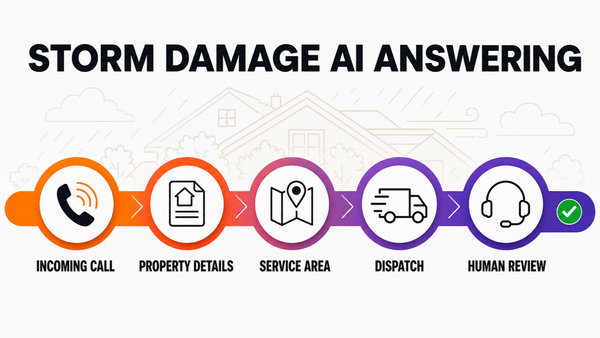
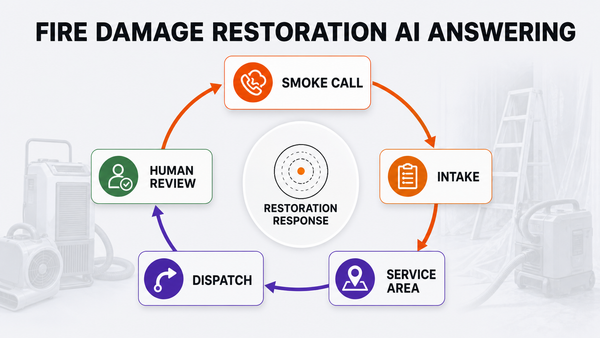
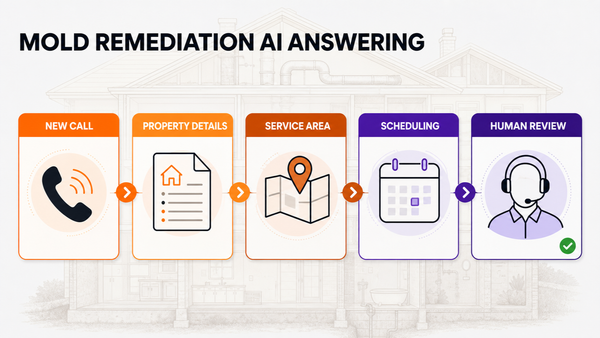
The safe workflow: answer, classify, draft, approve, log
| Step | Workflow role | Control point |
|---|---|---|
| 1. Inbound call | Answer after-hours, overflow, and emergency water calls. | AI can prepare or classify this step. |
| 2. Loss intake | Capture address, water source, affected areas, and active-water status. | AI can prepare or classify this step. |
| 3. Photo prompt | Request photos or notes when the workflow supports it. | AI can prepare or classify this step. |
| 4. Insurance context | Collect carrier and claim-status notes without coverage promises. | Human approval protects sensitive decisions. |
| 5. Owner approval | Approve safety language, dispatch, arrival windows, and pricing. | Human approval protects sensitive decisions. |
| 6. CRM log | Save transcript, summary, urgency, photos note, and next-step owner. | Human approval protects sensitive decisions. |
Where this automation should stay approval-gated
Keep these areas under owner, office manager, dispatcher, or technician review until the workflow has proven itself:
- safety instructions
- insurance coverage
- final pricing
- arrival-time promises
- crew dispatch
- hazardous water category
That approval layer is what separates useful AI operations from a risky phone bot that sounds confident while creating downstream cleanup work.
What to connect first
Start with overflow or after-hours missed-call capture. The first version should connect call forwarding, transcript storage, calendar or route rules, service-area rules, CRM or field-service software, and a review queue.
Once the intake flow is accurate, the managed layer should monitor accepted drafts, rejected drafts, misclassified calls, failed tool calls, unresolved customer replies, and recurring exceptions.
How Omni Studio fits
Omni Studio is a managed AI operations layer for home-service workflows. We map the call flow, create the intake script, define approval rules, connect the source systems, monitor exceptions, and improve the workflow after launch.
If you are evaluating this workflow, start with an AI automation audit. If the workflow is already close to live operations, review managed AI Ops. If you need to decide whether the workflow is ready for AI, use the AI Ops readiness scorecard.
FAQ
What is a water damage restoration AI answering service?
A water damage restoration AI answering service captures emergency calls, address details, active water status, affected areas, photos or notes, insurance context, and callback details so the restoration team can approve the next step.
Can AI dispatch a water damage crew automatically?
AI can draft an urgent summary and alert the team, but final crew dispatch, arrival windows, safety-sensitive language, pricing, and insurance statements should stay approval-gated.
What should water damage AI answering collect?
It should collect name, phone, address, water source, affected areas, whether water is still coming in, photos if available, insurance context, access notes, and urgency.
How does Omni Studio protect restoration workflows?
Omni Studio maps the intake path, defines approval gates, connects the CRM or dispatch system, logs every call, and monitors exceptions after launch.